浪花一朵朵
Economist explores human stories behind development_我的网站

A |
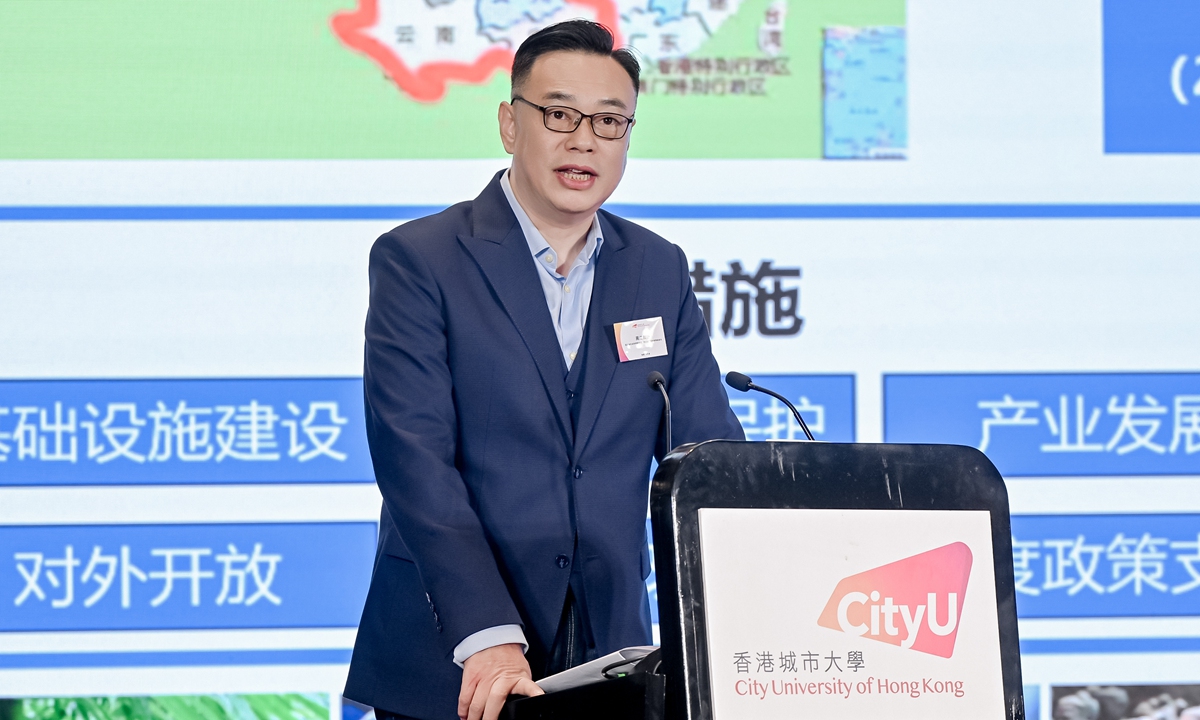
Zhou Jiang speaks at an event. Photo: Courtesy of Zhou Jiang
Zhou Jiang, a researcher at the Sichuan Academy of Social Sciences, has a favorite book:
White Deer Tableland or
Bai Lu Yuan by renowned writer Chen Zhongshi.
As vice president of the Regional Science Association of China (RSAC), Zhou told the Global Times that a lifetime of reading has profoundly shaped the way he sees and understands the world. It ultimately led him to a career in research and academia, where he teaches and pursues scholarly work.
Since earning his PhD in economics in 2000, he has devoted himself to the study of regional science and economics, a field that demands a constant crossing of disciplinary boundaries, drawing on the fields of geography, sociology, history, and ecology among others.
"Reading has kept alive my sense of curiosity and taught me to ask questions with patience and persistence: Where do disparities in regional development come from? How do policies affect different groups in society? And how can a region pursue both efficiency and equity so that development is not merely effective, but also imbued with a greater sense of humanity and warmth?" Zhou noted.
Founded in 1991, RSAC is a national academic society dedicated to advancing domestic and international academic exchange and cooperation, providing consulting services on spatial planning, urbanization, and regional development, and offering intellectual support for China's modernization drive.
The 57-year-old researcher noted that reading has empowered him in two distinct ways.
"The first is discernment. When confronted with a complex issue, I try not to settle for a simple conclusion. Instead, I make an effort to understand its broader context, how it has unfolded, and the perspectives of the different people involved," he said.
"The second is a sense of inner steadiness. Setbacks are an inevitable part of both life and work. Good books remind us that hardship is never ours alone to bear; countless people before us have faced circumstances more difficult than our own, made difficult choices, and found the strength to carry on. Reading cannot solve every problem for us, but it can help us remain calm when challenges arise, giving us the clarity and resilience that allow us not to panic or give up too easily," he said.
Historical depth
Each time Zhou returns to the White Deer Tableland, he finds something different in its pages.
"When I first read it as a young person, I was drawn primarily to the characters and the twists and turns of their lives. Later, as I began researching regional economics, I found myself paying closer attention to the changes in the land, the countryside, families and social order presented in the story. Now, approaching 60, I have come to appreciate more deeply the choices the characters make, the constraints they face, and the quiet perseverance they show amid the sweeping currents of their times," he said.
White Deer Tableland uses Bai Lu village in Northwest China's Shaanxi Province as a microcosm, tracing the feuds and intertwined fortunes of three generations of the Bai (literally meaning white) and Lu families. Through their stories, it captures more than half a century of sweeping historical change, from the final years of the Qing Dynasty (1644-1911) to the 1970s and 1980s. The novel won the Mao Dun Literature Prize, one of China's top literature awards, in 1997.
Zhou prefers literary works with historical depth and a keen eye for social change.
Regional economics may appear to be concerned with the spatial distribution of industries, population and resources, but at its heart, it is about how people live on a particular piece of land, and why some places flourish while others decline, he noted.
In this sense, literature and history are more than pastimes beyond professional research. They often help him understand the historical context, cultural traditions and social mentality that lie behind economic data, he said.
When reading novels, Zhou said that he often pays close attention to the relationship between people and the places they inhabit: How the land shapes the local character, how transportation transforms a region, and how shifts in industry reshape families and villages. Such details may not offer a direct conclusion, but they broaden a researcher's perspective. They also serve as a reminder that research should look beyond growth rates and statistical indicators to consider the sense of fulfillment experienced by ordinary people and the dignity of human beings.
Understanding ourselvesOnce, while tidying his study, he came across a book filled with notes he had scribbled in his early years. Among them was a question that particularly caught his attention: "In the face of sweeping changes in the times and profound social transformation, what can a person truly determine for himself?"
Looking at those words he had written in his youth was like coming face to face with the person he had been decades ago.
Reading is not simply the act of understanding a book; it is also a record of a person's own growth, he said. The same book can reveal something entirely different when read at different stages of life.
When we are young, we turn to books in search of answers; but when we become seasoned, we read more to understand life, to understand others, and ultimately, to better understand ourselves, Zhou said.
In this era of fragmented information, AI can help people access information quickly, organize materials, and gain a basic understanding of unfamiliar fields. Yet deep reading, Zhou said, allows people to see how a conclusion is reached — what evidence supports it, where its boundaries lie, and what alternative interpretations it may invite.
What truly shapes a person, after all, is not how much information they have browsed, but the words that have made them pause and reflect - and the words that have remained with them for many years, he added.
。
(ECNS) -- A satellite pair with onboard artificial intelligence processing capabilities were successfully launched into orbit in early August, marking the latest milestone in the country’s rapidly expanding commercial space sector. The Eastern Star link 05/06 satellites, launched aboard a Jielong-3 carrier rocket from the Haiyang Oriental Spaceport, Shandong Province, were jointly developed by Wuhan University, Eastern Star link and Star Vision, two Chinese commercial space and satellite technology companies. The satellites are equipped with hyperspectral AI capabilities for intelligent data processing in orbit. Unlike traditional remote-sensing satellites, which send large amounts of imagery back to Earth for analysis, the new satellites can process data directly in space. According to Song Bingchen, co-founder of Eastern Star link, the technology could shorten information response times from days to minutes and increase data utilization rates from less than 10% to more than 80 %. However, deploying AI in space presents challenges, including limited power supply, heat dissipation and radiation resistance. To overcome them, the company has been exploring the deployment of artificial intelligence systems in high Earth orbit and conducting ongoing experiments with in-orbit computing. Its AI hardware payloads have been operating in orbit for more than 2,600 days. The development reflects the growing role of private enterprises in China’s commercial space sector. At a private economy forum held in Hangzhou, Zhejiang Province, on Monday, Song said the company’s goal is to “deploy artificial intelligence in space”. He noted that Hangzhou has brought together aerospace institutions, research centers and space-related companies, creating an ecosystem for commercial space development. The Yunqi Town area, where Eastern Star link and Star Vision are based, is now home to more than 300 aerospace information companies. Eastern Star link’s business has expanded to more than 40 countries and regions. Song that added embracing challenges and setbacks is essential for commercial space development and technological innovation. (By Intern Liu Shuangjing, Zhang Dongfang)


。
Current article:http://p8ubt6.shuicengchongmingnouhuawang.bond/ahhst5/98y0vp.html
Published on:00:41:09

 。
。


